审阅范围 · Review scope
限定范围独立审阅。请保留正文中的出处与限制;不代表全库最终验收、实际演奏或学习效果验证。
Independent review within the stated scope. Keep the evidence and limitations stated in the text in view. This is not final corpus acceptance or validation of performance or learning outcomes.
从音符形状读到时间与琴键
看清形状,才能知道何时换音
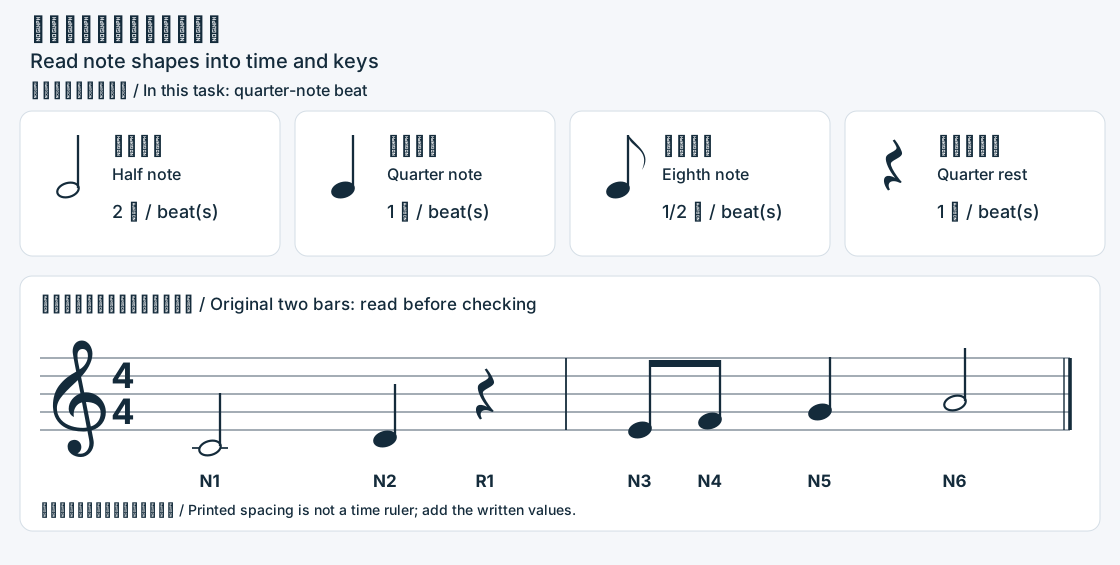
先看下方原创谱的N1和N2:它们都有一根符干,但音头一个空心、一个实心。是否各占一拍?再看R1:没有音高,是否就没有时间?先写预测或“不确定”,读完图例后再核答案。
前置是能从普通高音谱号的G4参照线读自然音;需要时先做谱号与线间课。本课只用一个声部、普通高音谱号、无调号的自然音和4/4;没有临时记号、附点、延音线、连音组、踏板或中途换拍。图中N1–N6和R1只是查表编号,不是拍次或指法。
三种音符,一种休止
音头中心的线间位置决定本例的音名;空心或实心、符干和符尾帮助读时值。空心音头加符干是二分音符;实心音头加符干、既无符尾也无符杠的是四分音符;实心音头加符干及一条符尾的是八分音符。形状不是响度要求,符干顶端也不决定音高。
本题明确以四分音符为一拍:二分占2拍、四分占1拍、八分占半拍。图例中的八分音符独立带符尾;谱中N3与N4用一条符杠相连,每音仍是半拍,两音合计1拍。这里没有连音组数字;符杠不是让两个音合成一次起音的延音线。
四分休止符占1拍,但没有要弹的音高、八度或琴键。不要把它读成又敲一下,也不要删去这段时间。这里的休止是这个声部的记谱要求,不保证房间里绝对没有余响。
从谱面填一张时间表
每小节数1、2、3、4;遇八分音符,可把每拍均分为“拍次数字、&”两份,如“1 & 2 & 3 & 4 &”。&只是半拍标签,不是新的一拍。本题用q表示从全段开头起已经经过的四分音符单位:第一小节从q=0开始,第二小节从q=4开始。小节拍次从1计,经过时间从0计。
先遮住答案,对每个编号依次写:音符还是休止→形状名称→时值→起点与终点;只有音符再写谱号、线间位置、音名与八度、琴键。后一项的起点是前一项的终点;休止也参加累加。不要用谱面上两个符号的像素距离猜时长。
此表的终点只表示谱写时值结束,并非测得的放键或声音消失。跨过一个拍点而没有新音头时,前音仍可占着时值;不为每个拍点都加一次敲键。具体连断、放键与余响是之后另查的演奏问题。
核对七项,而不只数六个音头
第一小节是2+1+1=4拍;第二小节是半拍+半拍+1拍+2拍=4拍。共有6个有音高的音符和1个休止对象,要求6次新起音,位置为q=0、2、4、4.5、5、6。q=1和q=7延续前音的谱写时值;q=3开始一拍休止。全段在q=8结束,不是第六次起音处结束。
位置s沿用谱号课:最下线为0,向上相邻线或间加1。中央C4在高音谱表第一条下加线,s=−2;D4为−1,E4为0,随后F4、G4、A4为1、2、3。88键序号从最左A0=1起把黑白键都数入;不是白键序号。音名后的4是八度,不是手指号。
只有另给速度,才能换算秒数。本题的换算例固定为四分音符=60 BPM,因此1q=1秒、每小节4秒、全段8秒。这是计划时长,不是录音或演奏结果;八分音符不会因为叫“八分”就占八拍。
| 编号 | 小节/拍内起点 | 类型 | 音名/位置s | 88键 | 起点q | 时值q | 终点q |
|---|---|---|---|---|---|---|---|
| N1 | 1 / 1 | 二分音符 | C4 / -2 | 40 | 0 | 2 | 2 |
| N2 | 1 / 3 | 四分音符 | D4 / -1 | 42 | 2 | 1 | 3 |
| R1 | 1 / 4 | 四分休止符 | — | — | 3 | 1 | 4 |
| N3 | 2 / 1 | 八分音符 | E4 / 0 | 44 | 4 | 0.5 | 4.5 |
| N4 | 2 / 1-& | 八分音符 | F4 / 1 | 45 | 4.5 | 0.5 | 5 |
| N5 | 2 / 2 | 四分音符 | G4 / 2 | 47 | 5 | 1 | 6 |
| N6 | 2 / 3 | 二分音符 | A4 / 3 | 49 | 6 | 2 | 8 |
文字等价谱(已揭露):C4二分、D4四分、四分休止|E4八分、F4八分、G4四分、A4二分。
定位错误,再回到两小节
先只核N1、N2、R1:是否把空心读成实心、忘了休止的一拍,或把N1的第二拍另加起音?再核N3、N4:是否把一条符杠误当一次起音或每音一拍?纠正后重算全段七项,确认两小节各4拍和最后终点q=8。
把形状/时值、起点、音名/八度、琴键错误分别记下;不能把纸面算错归为手指问题。可选原声琴核对只需逐个找六个目标键,不要求把整段按速度弹出、同时按多个音或使用固定指法。高音谱号不自动指定右手。
下次先遮答案,记录真实间隔,再重读同一两小节;这是熟悉材料的保留检查,不是陌生谱迁移或首次视奏。可以默数、说数或只写表;纸面正确、找到琴键、实际弹奏、内听与学习效果分别记录,未做的保持“未尝试”。
来源、原创部分与边界
NC-153的90.09秒静帧把可见音符形状与名称配对,300.3秒静帧把休止符形状与名称配对。本次只保留这两张图的可见符号及标签;没有从无声静帧补出讲解、速度或完整示范。它是已有本地NC-153静态范围的延伸,新增来源ID为0;历史已发布107/399的ASR文字/选帧范围不变。
Puget Sound教材第4.2节在4/4语境说明时值比例并列出音符和休止图;本课使用这些常规比例,不复制其谱例或听觉练习。第4.6节另说明符杠可帮助看出拍的组织。本课两小节、图例布局、时间表、键位答案与练习流程均为原创。
MusicXML的duration定义区分意图时长、记谱时长以及演奏特有的起止调整;本课没有生成MusicXML,只保留“书面时间表不是实际演奏测量”的边界。没有阅读原始ASR、运行新ASR、听校、连续动作或学习者测试。
前置:谱号与线间;节奏;之后:小节与延音线;源范围;原创数据。
Read note shapes into time and keys
Read the shape before deciding when the next note starts
Look at N1 and N2 in the original score below. Both have stems, but one notehead is open and the other filled. Does each last one beat? R1 has no pitch: does it occupy no time? Record a prediction or “uncertain,” read the legend, then check the answers.
First be able to read natural pitches from the ordinary treble clef’s G4 reference line; use the clef-and-staff lesson if needed. This lesson uses one voice, ordinary treble clef, natural notes without a key signature, and 4/4. There are no accidentals, dots, ties, tuplets, pedal or meter changes. N1–N6 and R1 are lookup labels, not beat numbers or fingerings.
Three note values and one rest
The notehead’s staff position determines pitch here; open or filled heads, stems and flags help identify duration. An open head with a stem is a half note. A filled head with a stem and neither flag nor beam is a quarter note. A filled head with a stem and one flag is an eighth note. Shape does not specify loudness, and the stem tip does not determine pitch.
This task explicitly uses a quarter-note beat: a half note lasts 2 beats, a quarter 1, and an eighth half a beat. The legend shows a flagged eighth; N3 and N4 share one beam, but each still lasts half a beat and the pair totals 1 beat. There is no tuplet number. A beam is not a tie merging the notes into one attack.
A quarter rest occupies 1 beat but has no pitch, octave or key to play. It requests neither another attack nor deletion of that time. Here it specifies a rest in this voice; it does not guarantee that all acoustic resonance vanishes.
Fill a timeline from the score
Count 1, 2, 3, 4 within each bar. For eighths, split each beat evenly into its number and “and”: “1 and 2 and 3 and 4 and.” “And” labels a half-beat position, not another beat. Here q measures elapsed quarter-note units from the passage’s start: bar 1 begins at q=0 and bar 2 at q=4. Beat numbers begin at 1; elapsed time begins at 0.
Hide the answers and write, for each label: note or rest → shape name → duration → start and end. For notes, also identify clef, staff position, pitch with octave, and key. The next object starts where the previous one ends; include rests in the sum. Do not estimate duration from the printed distance between symbols.
An endpoint in this table ends the written duration; it is not a measured key release or acoustic cutoff. When a beat boundary has no new notehead, the earlier note may still occupy its duration. Do not add an attack at every beat. Articulation, release and resonance are separate performance questions.
Check seven objects, not only six noteheads
Bar 1 totals 2+1+1=4 beats; bar 2 totals half+half+1+2=4 beats. There are 6 pitched notes and 1 rest object, requiring 6 attacks at q=0, 2, 4, 4.5, 5 and 6. At q=1 and q=7 the preceding note’s written duration continues; q=3 begins a one-beat rest. The passage ends at q=8, not at its sixth attack.
Position s follows the clef lesson: the bottom line is 0, and each neighboring line or space upward adds 1. Middle C4 is on the first lower ledger line, s=−2; D4 is −1, E4 is 0, and F4, G4 and A4 are 1, 2 and 3. The 88-key index counts black and white keys from the leftmost A0=1, not white keys alone. The 4 in a pitch name indicates octave, not finger number.
Seconds require a stated tempo. This task’s conversion example fixes quarter note=60 BPM, so 1q=1 second, each bar lasts 4 seconds, and the passage 8 seconds. These are planned durations, not recording or performance results. An eighth note does not last eight beats because of its name.
| ID | Bar / beat onset | Type | Pitch / position s | 88-key | Start q | Duration q | End q |
|---|---|---|---|---|---|---|---|
| N1 | 1 / 1 | Half note | C4 / -2 | 40 | 0 | 2 | 2 |
| N2 | 1 / 3 | Quarter note | D4 / -1 | 42 | 2 | 1 | 3 |
| R1 | 1 / 4 | Quarter rest | — | — | 3 | 1 | 4 |
| N3 | 2 / 1 | Eighth note | E4 / 0 | 44 | 4 | 0.5 | 4.5 |
| N4 | 2 / 1-& | Eighth note | F4 / 1 | 45 | 4.5 | 0.5 | 5 |
| N5 | 2 / 2 | Quarter note | G4 / 2 | 47 | 5 | 1 | 6 |
| N6 | 2 / 3 | Half note | A4 / 3 | 49 | 6 | 2 | 8 |
Disclosed text equivalent: C4 half, D4 quarter, quarter rest | E4 eighth, F4 eighth, G4 quarter, A4 half.
Locate the error, then return to both bars
First check N1, N2 and R1: did you confuse an open head with a filled one, omit the rest’s beat, or add an attack during N1’s second beat? Then check N3 and N4: did one beam become one attack, or did each eighth become a full beat? After correcting the local error, recalculate all seven objects, both four-beat bars and the final endpoint q=8.
Record shape/duration, onset, pitch/octave and key errors separately; a paper mistake is not a finger diagnosis. Optional acoustic-piano checking means locating the six target keys individually. It does not require playing the passage at tempo, pressing notes together or using prescribed fingering. Treble clef does not automatically mean right hand.
Next time, hide the answers, record the actual interval, and reread the same two bars. This checks familiar-material retention, not transfer to unseen notation or first-time sight-reading. Count silently, aloud or only on paper. Record paper accuracy, key location, performance, audiation and learning outcomes separately; leave unattempted tasks unattempted.
Sources, original work and limits
The NC-153 still at 90.09 seconds pairs visible note shapes with names; the still at 300.3 seconds pairs rest shapes with names. Only those visible symbols and labels are retained. No speech, tempo or complete demonstration is inferred from silent stills. This extends the existing local NC-153 static scope, adds 0 source IDs and leaves the historical published 107/399 ASR-text/selected-still scope unchanged.
Puget Sound’s Section 4.2 explains duration proportions in 4/4 and provides note/rest diagrams. This lesson uses those standard proportions without copying its score examples or listening exercise. Section 4.6 separately explains beaming’s role in showing beats. Our two bars, legend layout, timeline, key answers and practice procedure are original.
MusicXML’s duration definition distinguishes intended duration, notation and performance-specific attack/release adjustments. This lesson generates no MusicXML; it retains the boundary that a written timeline is not a performance measurement. No original ASR reading, new ASR, audition, continuous-motion review or learner test occurred.
Prerequisite: clef and staff; rhythm; next: bars and ties; source scope; original data.