审阅范围 · Review scope
限定范围独立审阅。请保留正文中的出处与限制;不代表全库最终验收、实际演奏或学习效果验证。
Independent review within the stated scope. Keep the evidence and limitations stated in the text in view. This is not final corpus acceptance or validation of performance or learning outcomes.
调号与临时记号:这一音现在弹哪个键?
眼前没有升号,就一定弹白键吗?
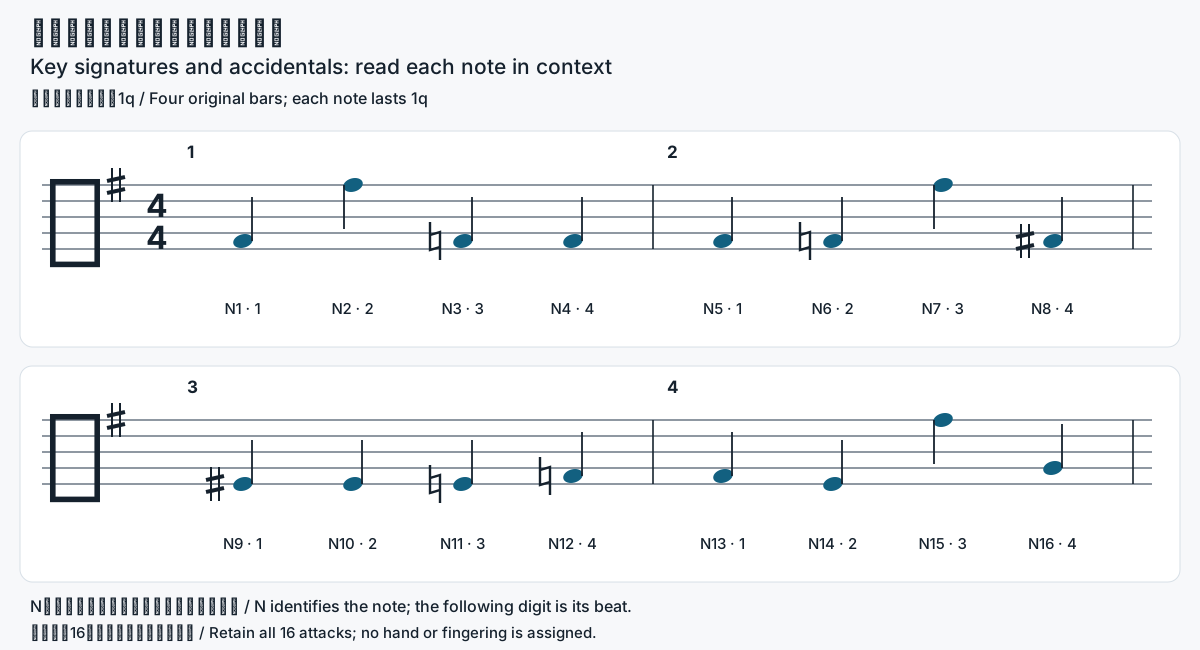
先看原创谱第1小节的N1与N4:两个音头都在高音谱表的第一间F4,旁边都没有临时记号。它们应弹同一个键吗?先记下预测或“不确定”。本课练习把前面的调号和本小节已经出现的记号带到当前音符,而不是只看眼前一个音头。
先会认普通高音谱号、音名与八度、四分音符和4/4拍。下图给定一个升号的调号:所有八度的F默认升半音;其他字母默认自然音。图中调号的升号写在F5位置,但作用不只限于F5。这里不根据调号或结尾G4推断整段已建立何种调性。
本课只处理固定高音谱号、一个谱表、一个声部的普通钢琴记谱。四小节全是四分音符;没有延音线、跨谱表、换谱号、八度移位、装饰音、踏板、反复或提示性临时记号。特别是跨小节延音线有另外的规则,不能把本课的重置步骤直接套过去。
三步判断:本音符、本小节、调号
先按谱号找出字母和八度,暂不把它当成最终键位。接着依次判断:本音符有没有明确临时记号?若有,采用它;若没有,同小节此前是否已给相同字母、相同八度设过临时记号?若有,沿用最近一次;两者都没有,才用调号默认值。
为本例在纸上分开记F4、F5和E4,不把所有F混成一格。F4旁的还原号会让本音及本小节后续无新记号的F4读成F4;它不改F5,也不改E4。来到新的小节,清掉这张临时记录,调号仍保留,所以无新记号的F又从F#开始。
这是本课限定的读法,不是对所有时代、版本和排版习惯的概括。出版谱可能多印提示性的升降或还原号帮助阅读;本例刻意不用它们,方便检查何时必须从前文取回信息。范围依据见文末所列教材§4.5的局部与调号对照。
新记号替换旧值,不把半音叠加
♯表示比该字母的自然音高半音,♮表示该字母的自然音。这里的F#4就是F4升一个半音;若调号已经含F#,再看到F旁的♯也不是多升一次成为F双升。还原号也不是“总往下半音”:它指定自然音,具体方向取决于之前的状态。
第2小节N6把F4暂改为自然音;N7是另一个八度的F5,所以仍按调号为F#5;N8的♯把F4明确设回F#4。三次判断分别针对不同的音符,不能把N6的还原号涂到全小节所有F,也不能把N8的升号与调号相加。
第3小节N9与N10都是E#4,N11才用♮回到E4。E4与F4之间没有黑键,所以E#4落在与F4相同的白键;保留E#4拼写,不能因此把谱上E位置改读成F位置。这也说明“升号一定是黑键”和“音头旁无记号一定是白键”都不成立。
| 音名 | 半音坐标 | 88键序号 | 键色 |
|---|---|---|---|
| E4 | 64 | 44 | 白 |
| E#4 | 65 | 45 | 白 |
| F4 | 65 | 45 | 白 |
| F#4 | 66 | 46 | 黑 |
| G4 | 67 | 47 | 白 |
| F#5 | 78 | 58 | 黑 |
四小节原例:逐音留下判断理由
每小节从第1拍数到第4拍。q是四分音符单位,全局起点q=0、终点q=16,小节起点分别为0、4、8、12。N1至N16各占1q且各有一次起音,没有休止或延音线;即使连续音键位相同,也不能偷偷合并成长音。
表中“谱位”只记录字母与八度;“明确记号”列的—表示当前音符旁没有新记号,不表示还原号。“解析音”已把调号与本小节上下文计算进去。半音坐标以C4=60;88键序号把黑白键都算入,从A0=1开始,等于半音坐标−20;无需MIDI设备。
核对N4与N5:N4沿用N3的还原,弹F4;N5来到新小节,恢复调号默认而弹F#4。再核对N12与N13:同样是小节边界把F4局部还原清掉。N14的E4则用默认自然音;前小节曾经有E#,不代表以后所有E都升。
| ID | 小节:拍 | 谱位 | 明确记号 | 解析音 | 半音坐标 | 88键 | 理由 |
|---|---|---|---|---|---|---|---|
| N1 | 1:1 | F4 | — | F#4 | 66 | 46 | 调号默认 |
| N2 | 1:2 | F5 | — | F#5 | 78 | 58 | 调号默认 |
| N3 | 1:3 | F4 | ♮ | F4 | 65 | 45 | 本音符记号 |
| N4 | 1:4 | F4 | — | F4 | 65 | 45 | 本小节沿用 |
| N5 | 2:1 | F4 | — | F#4 | 66 | 46 | 调号默认 |
| N6 | 2:2 | F4 | ♮ | F4 | 65 | 45 | 本音符记号 |
| N7 | 2:3 | F5 | — | F#5 | 78 | 58 | 调号默认 |
| N8 | 2:4 | F4 | ♯ | F#4 | 66 | 46 | 本音符记号 |
| N9 | 3:1 | E4 | ♯ | E#4 | 65 | 45 | 本音符记号 |
| N10 | 3:2 | E4 | — | E#4 | 65 | 45 | 本小节沿用 |
| N11 | 3:3 | E4 | ♮ | E4 | 64 | 44 | 本音符记号 |
| N12 | 3:4 | F4 | ♮ | F4 | 65 | 45 | 本音符记号 |
| N13 | 4:1 | F4 | — | F#4 | 66 | 46 | 调号默认 |
| N14 | 4:2 | E4 | — | E4 | 64 | 44 | 调号默认 |
| N15 | 4:3 | F5 | — | F#5 | 78 | 58 | 调号默认 |
| N16 | 4:4 | G4 | — | G4 | 67 | 47 | 调号默认 |
从小节中间开始,要带上前文
只截取N4时,查看窗口是q=[3,4),其中没有印还原号,但这并不把它改成F#4。它仍继承本小节N3设置的F4自然音。窗口左边缘不是新的小节线,不能自动清空临时记录。
本课可执行的局部检查从N3开始,走第1小节第3、4拍,即q=[2,4),共2q;保留高音谱号和一个升号的调号。N3的明确还原号建立需要的上下文,再读N4。这个片段不是新写的2/4小节,也不代表完整四小节已经完成。
局部核对后回到N1重读完整四小节。若要单独另写一个从N4开始的练习,必须明示所带的临时状态或重新写出必要记号,并把它标作改写版本;不能删掉前文后仍声称无条件保留原谱意义。
纸上预测、可选找键与延后复测
遮住答案表,先逐音写谱位、当前明确记号、有效音名及理由。每次跨小节先划掉上小节临时记录,但保留“F默认升”的调号行。错了就分开记:漏调号、漏沿用、误跨八度、没重置、叠加半音或改错拼写;不要把纸面判断错误直接归咎于手指。
可选钢琴路线先一个音一个音找键,允许停下来核对;这只算键位检查,不算连续演奏。愿意连读时再选能读清的速度,保留四小节和全部16次起音,不要求固定手、指法或不间断跨八度。示例四分音符=60 BPM时全段16秒,48 BPM时20秒;这些是算术示例,不是必须达到的速度。
记录路线、先于答案的预测、错误类别、完整四小节结果和下一步;未观察的项目留未知。下一次先遮住答案重做同一材料,记真实间隔后再纠错。这是熟悉材料的延迟保留检查,不是陌生谱迁移、内听或真实学习效果已经通过。
来源与原创范围
本次直接查看NC-153的三张选定静帧:520.0195秒键盘图把E#标在白键上;545.002792秒标注同八度重复音继续F#、另一八度不受影响,并说明下一小节的还原号只是可选提醒;565.022792秒以文字和箭头标出调号符号群。这里只确认可见标签、图形与局部关系,没有听校或连续观看。
调号跨八度与临时记号局部作用的规则另核《Steps to Music Theory》§4.5;E#键位、记号替换及局部作用另核§2.2。♯与♮的定义也参照Puget Sound教材§1.4。这是指定段落的概念核对,没有新增教材全章、嵌入音频或完整谱例验收。
本课四小节、逐音表、上下文窗口和练习流程均为原创设计,不复制课程谱例。标准记谱规则不是本库发明;原视频并未给出本例的科学八度编号、88键编号或16音答案。NC-153已在上一批有静态证据,本批只扩展同一来源范围:新增唯一来源0,既有107/399的ASR文字/选帧范围不变。没有新增ASR阅读或运行、原声听校、连续动作或演奏/效果验收。
前置:谱号、线间与自然音、音名与拍;衔接:音程拼写、跨延音线数小节;本课来源范围。
Key signatures and accidentals: which key does this note require?
Does no sharp beside the note mean a white key?
Look at N1 and N4 in bar 1 of the original score: both noteheads occupy the treble staff’s first space, F4, and neither has a local accidental beside it. Do they require the same key? Record a prediction or “uncertain.” This lesson carries the signature and earlier marks in the current bar forward to the note being read.
Begin with ordinary treble-clef reading, note names and octaves, quarter notes and 4/4. The score specifies a one-sharp signature: F defaults to sharp in every octave, while other letters default to natural. The signature’s sharp is drawn at F5, but its effect is not limited to F5. Neither the signature nor the final G4 is treated as proof of the passage’s tonality.
This unit uses ordinary piano notation with one fixed treble staff and one voice. All four bars contain quarter notes. There are no ties, cross-staff notes, clef changes, octave shifts, ornaments, pedal, repeats or courtesy accidentals. In particular, ties across barlines need additional rules; do not apply this unit’s reset procedure to them unchanged.
Three checks: this note, this bar, the signature
First read the letter and octave from the clef, without treating that position as the final key. Then ask in order: does this note have an explicit accidental? If so, use it. Otherwise, has an earlier accidental in this bar set the same letter in the same octave? If so, retain the most recent one. If neither applies, use the signature’s default.
For this example, keep separate paper entries for F4,F5 and E4 rather than combining all Fs. A natural beside F4 makes that note and later unmarked F4s in the same bar natural; it does not change F5 or E4. At a new bar, clear these local entries while retaining the signature, so an unmarked F again starts from F#.
This is the reading rule for the stated scope, not a claim about every period, edition or engraving style. Editions may add reminder accidentals; this example deliberately omits them to expose where earlier context is needed. The textbook comparison in section 4.5 cited below supplies the local-versus-signature distinction.
A new sign replaces the alteration; it does not stack
A sharp, ♯, means one semitone above that letter’s natural pitch; a natural, ♮, specifies its natural pitch. F#4 is one semitone above F4. If the signature already includes F#, another sharp beside F does not add a second semitone and make F double-sharp. A natural is not an instruction to always move downward one semitone: it specifies the natural pitch, and the change depends on the previous alteration.
In bar 2, N6 temporarily makes F4 natural. N7 is F5 in another octave, so it remains F#5 under the signature. N8’s sharp explicitly sets F4 back to F#4. These are separate decisions: N6’s natural does not alter every F in the bar, and N8’s sharp is not added to the signature.
In bar 3, N9 and N10 are E#4; N11 then uses a natural to return to E4. There is no black key between E4 and F4, so E#4 uses the same white key as F4. Preserve the E#4 spelling rather than reading the written E position as F. Both “a sharp always means a black key” and “no sign beside the note always means a white key” fail.
| Pitch | Semitone coordinate | 88-key index | Key color |
|---|---|---|---|
| E4 | 64 | 44 | white |
| E#4 | 65 | 45 | white |
| F4 | 65 | 45 | white |
| F#4 | 66 | 46 | black |
| G4 | 67 | 47 | white |
| F#5 | 78 | 58 | black |
Four original bars: retain a reason for every pitch
Count beats 1 through 4 in each bar. Here q is a quarter-note unit: the passage starts at q=0 and ends at q=16, with bar starts at 0,4,8,12. N1 through N16 each occupy 1q and each has one attack. There are no rests or ties, so repeated pitches must not be silently merged into a longer note.
The “staff pitch” column records the letter and octave only. A dash under “explicit sign” means there is no new sign beside this note; it does not mean a natural. “Resolved pitch” includes the signature and current-bar context. Semitone coordinates use C4=60. The 88-key index counts white and black keys from A0=1 and equals that coordinate minus 20; no MIDI device is required.
Compare N4 with N5: N4 retains N3’s natural and uses F4, whereas N5 enters a new bar and returns to the signature default F#4. N12 to N13 provides another reset of the local F4 natural. N14 uses the default E4 natural; E# in an earlier bar does not sharpen every later E.
| ID | Bar:beat | Staff pitch | Explicit sign | Resolved pitch | Semitone | 88-key | Reason |
|---|---|---|---|---|---|---|---|
| N1 | 1:1 | F4 | — | F#4 | 66 | 46 | signature/default |
| N2 | 1:2 | F5 | — | F#5 | 78 | 58 | signature/default |
| N3 | 1:3 | F4 | ♮ | F4 | 65 | 45 | this sign |
| N4 | 1:4 | F4 | — | F4 | 65 | 45 | within-bar carry |
| N5 | 2:1 | F4 | — | F#4 | 66 | 46 | signature/default |
| N6 | 2:2 | F4 | ♮ | F4 | 65 | 45 | this sign |
| N7 | 2:3 | F5 | — | F#5 | 78 | 58 | signature/default |
| N8 | 2:4 | F4 | ♯ | F#4 | 66 | 46 | this sign |
| N9 | 3:1 | E4 | ♯ | E#4 | 65 | 45 | this sign |
| N10 | 3:2 | E4 | — | E#4 | 65 | 45 | within-bar carry |
| N11 | 3:3 | E4 | ♮ | E4 | 64 | 44 | this sign |
| N12 | 3:4 | F4 | ♮ | F4 | 65 | 45 | this sign |
| N13 | 4:1 | F4 | — | F#4 | 66 | 46 | signature/default |
| N14 | 4:2 | E4 | — | E4 | 64 | 44 | signature/default |
| N15 | 4:3 | F5 | — | F#5 | 78 | 58 | signature/default |
| N16 | 4:4 | G4 | — | G4 | 67 | 47 | signature/default |
Starting mid-bar needs the earlier context
A view containing only N4 spans q=[3,4). It shows no natural sign, but that does not turn N4 into F#4: it still inherits the F4 natural set by N3 in the same bar. The left edge of a viewing window is not a new barline and must not automatically clear local context.
The executable local check starts at N3 and covers beats 3 and 4 of bar 1, q=[2,4), for 2q. Retain the treble clef and one-sharp signature. N3’s explicit natural establishes the needed context before N4. This fragment is not a newly written 2/4 bar and does not count as completing all four bars.
After checking the fragment, return to N1 and read the complete four bars. A separately written exercise beginning at N4 must explicitly carry the local context or print the necessary sign and be labeled as an adapted version. Removing the earlier context cannot silently preserve the original reading.
Paper prediction, optional key finding and a delayed retest
Cover the answer table and write each staff pitch, explicit sign, resolved pitch and reason. At each barline, cross out the previous bar’s local entries while retaining the “F defaults to sharp” signature row. Classify errors as missed signature, missed carry, wrong-octave carry, missed reset, added alterations or changed spelling rather than attributing a paper error directly to the fingers.
For the optional piano route, find one key at a time and pause to check as needed; this counts as key finding, not continuous performance. If choosing to read continuously, use a manageable tempo and retain all four bars and all 16 attacks. No hand, fingering or uninterrupted octave leap is prescribed. At illustrative quarter-note tempos of 60 and 48 BPM the passage lasts 16 and 20 seconds respectively; these are arithmetic examples, not required targets.
Record the route, predictions made before answers, error types, complete four-bar result and next action; leave unobserved outcomes unknown. At the next session, retry the same material with answers covered and record the actual interval before correcting. This checks delayed retention of familiar material, not transfer to unfamiliar notation, audiation or established learning effectiveness.
Source evidence and original material
This review directly inspected three selected NC-153 stills. At 520.0195 seconds a keyboard graphic labels E# on a white key. At 545.002792 the captions show same-octave F# carry, another octave unaffected, and the next bar’s natural as an optional reminder. At 565.022792 text and an arrow identify a key-signature cluster. These observations concern visible labels, graphics and local relations; no audio or continuous viewing was reviewed.
The signature’s octave-wide default and local accidentals were checked separately against Steps to Music Theory section 4.5. E# keyboard placement, replacement and local scope were checked in section 2.2; sharp and natural definitions also use Puget Sound section 1.4. This is a check of specified conceptual passages, not new acceptance of complete textbook chapters, embedded audio or full source scores.
The four bars, event table, context windows and practice procedure are original designs and do not copy the course example. The notation rules are standard conventions, not inventions here; the video does not supply this exercise’s octave numbers, 88-key indices or 16-note answers. NC-153 already has static evidence from the preceding batch: this extends the same source, adds zero unique sources, and leaves the existing 107/399 ASR-text/selected-still scope unchanged. No ASR was read or run, and audio, continuous motion, performance and learning outcomes remain unverified.
Prerequisites: clefs, staff steps and natural notes and note names and beat. Continue with interval spelling and counting bars through ties. See this lesson’s source scope.