审阅范围 · Review scope
限定范围独立审阅。请保留正文中的出处与限制;不代表全库最终验收、实际演奏或学习效果验证。
Independent review within the stated scope. Keep the evidence and limitations stated in the text in view. This is not final corpus acceptance or validation of performance or learning outcomes.
先认谱号,再数线与间
同一个位置,为什么不是同一个音?
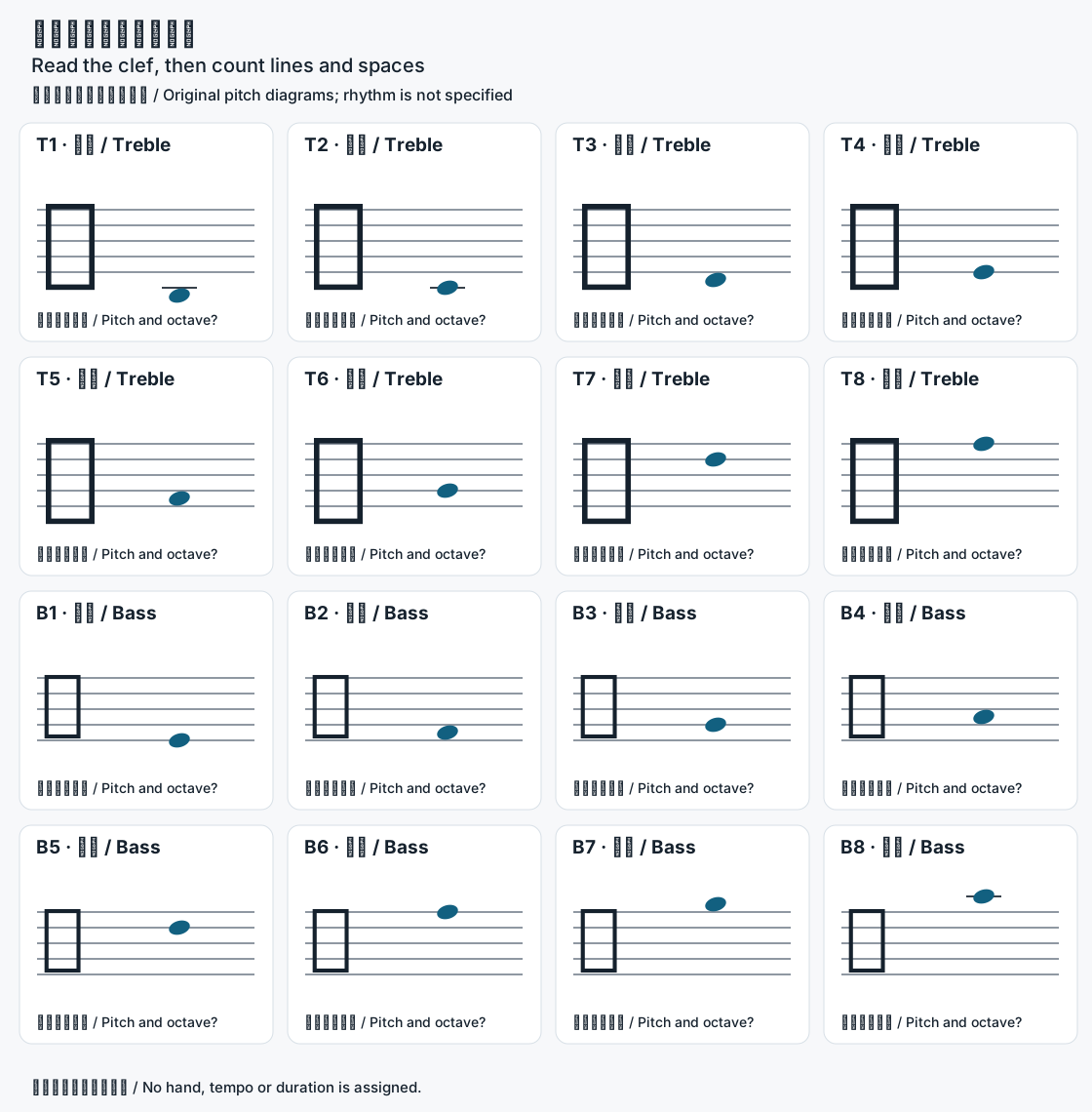
先看下方原创图的T4与B1:两个音头都在最下面一条线上。它们是同一个音、同一个琴键吗?先记下预测或“不确定”,再读参照规则。本课把谱号、线间位置、音名与八度、琴键分开核对。
本课只用普通钢琴记谱中的高音谱号与低音谱号,且固定在下文指定的位置。所有例子均无调号、无临时升降记号、无谱号上方或下方的8或15,也没有中途换谱号。这里只读自然音;遇到这些额外条件时,必须补查相应规则,不能直接套表。
图里的无符干实心椭圆只是音高位置标记,没有规定时值、拍号、速度、奏法或手。它们不是要连续弹奏的一行完整乐谱。可以全程纸笔完成;先认识C、D、E、F、G、A、B七个字母即可。
五条线,从下往上数
五线谱有五条线和它们之间的四个间。第一线是最下线,第五线是最上线;第一间在第一、第二线之间。看音头中心是在一条线上,还是在两条线中间,不要用符干顶端判断音高。
为便于核对,本课另设位置编号s:最下线为0,每向上走到相邻的间或线就加1,向下则减1。于是五条线对应0、2、4、6、8,四个内部间对应1、3、5、7。这是本课的坐标,不是谱上本来写着的指法、拍数或琴键号。
相邻线与间每走一步,字母就前进或后退一位。两个相邻的线中间还隔着一个间,所以从第一线到第二线是两步,不是一步。位置相同不保证音名相同:还要先确定谱号。
固定两个参照音
普通高音谱号是G谱号的一种位置:它的中心卷曲围绕第二线,本课把该线定为G4,即s=2。沿字母向下:第一间F4、第一线E4。向上则是第二间A4、第三线B4、第三间C5。
普通低音谱号是F谱号的一种位置:两个点分列第四线的上下,本课把该线定为F3,即s=6。向下依次是E3、D3、C3、B2、A2、G2;向上是G3、A3。线间图的竖直位置和所用谱号一起确定音名。
八度编号以C换档:B3再向上一位是C4,B4上去是C5;音名后的数字不是指法。C4是中央C。钢琴上向右音高升高,但谱纸上向右主要表示后面的内容;读音高先看竖直位置。
谱号不等于手的指令:高音谱号不自动指定右手,低音谱号也不自动指定左手。本课没有指定手或指法。若别的谱把G谱号或F谱号放在另一条线上,必须重新定位它的参照线,不能只认图形就套用这里的固定表。
加线与中央C:同一个键可以有两种位置
短加线延续五线谱的线间规律。高音谱表下方的D4在最下线下面相邻的间,s=−1,不需要加线;C4在再下一步的第一条下加线上,s=−2。B3位于那条加线下方的间,s=−3,图中仍要画出它上面的C4加线。
低音谱表上方的B3在最上线相邻的间,s=9,不需要加线;再上一步的C4在第一条上加线上,s=10。T2与B8都表示C4,虽然位置不同;T1与B7都表示B3。换写法没有把琴键移高或移低。
反过来,T4与B1虽同为s=0,却分别是E4与G2;T6与B3虽同为s=2,却分别是G4与B2。先看谱号,再数位置,才能避免把上下两张图硬套成同一音名表。
线间步数,不等于半音数
在这些自然音例子中,E4到F4只走一个线间步,也只升一个半音;F4到G4同样走一个线间步,却升两个半音。B2到C3是一个半音。不要把“往上一格”理解成“往右一个琴键”:这里的一格按字母计数。
答案中的半音坐标采用C4=60,每向上一个半音加1;它常称MIDI音符编号,但本课不需要MIDI设备。88键序号从最左端A0=1开始,把白键和黑键都算入;序号=半音坐标−20,所以C4是第40键,A0是第1键,C8是第88键。这不是“第40个白键”。
可选键盘核对:先找到一组两个黑键,它们紧邻左侧的白键是C;每组都有一个C,还要按八度位置确认中央C4。先单独找目标键,再与表中八度及序号比对。无需把多个例子同时按下,也没有规定速度或大跨度手形。
| 图号 | 谱号 | 位置s | 音名与八度 | 半音坐标 | 88键序号 |
|---|---|---|---|---|---|
| T1 | 高音 | -3 | B3 | 59 | 39 |
| T2 | 高音 | -2 | C4 | 60 | 40 |
| T3 | 高音 | -1 | D4 | 62 | 42 |
| T4 | 高音 | 0 | E4 | 64 | 44 |
| T5 | 高音 | 1 | F4 | 65 | 45 |
| T6 | 高音 | 2 | G4 | 67 | 47 |
| T7 | 高音 | 6 | D5 | 74 | 54 |
| T8 | 高音 | 8 | F5 | 77 | 57 |
| B1 | 低音 | 0 | G2 | 43 | 23 |
| B2 | 低音 | 1 | A2 | 45 | 25 |
| B3 | 低音 | 2 | B2 | 47 | 27 |
| B4 | 低音 | 3 | C3 | 48 | 28 |
| B5 | 低音 | 6 | F3 | 53 | 33 |
| B6 | 低音 | 8 | A3 | 57 | 37 |
| B7 | 低音 | 9 | B3 | 59 | 39 |
| B8 | 低音 | 10 | C4 | 60 | 40 |
先预测,再查表,再回到整组
先用T2、T6、B5、B8四图核对中央C和两个谱号参照音。遮住答案表,对每图依次写“谱号及参照线→位置s→音名与八度→琴键”。可以写“不确定”,不要预填通过。图号用于查表,不是弹奏顺序。
然后读完16图。若只错T1/T2的加线,先重画这两图,保留B3在加线下、C4在加线上的区别;再回到整组16图逐一核对。分别记录谱号、线间计数、字母、八度、琴键错误,不把任何纸面误读直接诊断成手指问题。
下次练习先遮住答案重做同一组,记录真实间隔和实际结果后再纠错。已公开的同一组只检查熟悉材料的保留,不能算陌生乐谱迁移、视奏流畅或内听能力已通过。纸面坐标正确、找到琴键、听出声音是不同结果。
这次来源到底支持了什么
本次直接查看NC-153恢复原视频的选定静帧。370.036333秒画面标出G谱号指定的G线;380.004625秒画面移动G谱号与音符位置,并注明音均为G。395.019625秒画面显示F谱号两点夹住指定F线;405.029625秒画面移动F谱号与音符位置,并注明音均为F。这里只记录可见文字、符号和相对位置。
这些画面没有标出科学八度编号或88键序号。普通高音G4/低音F3是本课采用的标准记谱约定;位置编号、16图、答案与练习流程是本库原创设计,不是对作者原句或完整源谱的转录。MusicXML的谱号线号定义另支持“从下数线、常规G谱号在第二线、F谱号在第四线”,不用于证明视频显示了八度编号。该视频展示可移动的参照线;本课据此强调先认谱号位置,再使用明确限定的普通钢琴谱例。
本次没有阅读原始ASR、运行新ASR、听校原声或检查连续动作,也没有验收完整源谱、实际演奏或学习效果。新来源证据是选帧静态范围,不能加入既有107/399的ASR文字/选帧联合范围,或改称新增一课已学完。
Read the clef, then count lines and spaces
Why can the same position name a different note?
Look at T4 and B1 in the original diagram below: both noteheads sit on the lowest staff line. Are they the same pitch and piano key? Record a prediction or “uncertain” before reading the reference rules. This lesson checks clef, staff position, note name and octave, and piano key separately.
The examples use ordinary piano notation with treble and bass clefs fixed in the positions specified below. There are no key signatures, accidentals, 8 or 15 markings above or below a clef, or mid-example clef changes. These are natural-note tasks; additional markings require their own rules before this table can be used.
The stemless filled ovals are pitch-position markers with no specified duration, meter, tempo, articulation or hand. They are not a complete passage to play in sequence. The task can be completed on paper; begin with the seven letters C, D, E, F, G, A, B.
Count five lines from the bottom
A staff has five lines and four spaces between them. Line 1 is the bottom line and line 5 the top; space 1 lies between lines 1 and 2. Read whether the notehead center lies on a line or between lines, rather than using the top of a stem to determine pitch.
For checking, this lesson defines a position coordinate s: the bottom line is 0, each adjacent space or line upward adds 1, and each step downward subtracts 1. The five lines therefore have coordinates 0,2,4,6,8 and the four internal spaces 1,3,5,7. This is our coordinate, not a fingering, beat count or piano-key number printed in the notation.
Each adjacent line-to-space or space-to-line move advances or retreats one letter. Two neighboring lines have a space between them, so line 1 to line 2 is two steps, not one. Equal positions do not guarantee equal note names: first identify the clef.
Fix two reference notes
The ordinary treble clef places the G-clef curl around line 2; here that line is G4, or s=2. Descending by letters gives F4 in space 1 and E4 on line 1. Ascending gives A4 in space 2, B4 on line 3, and C5 in space 3.
The ordinary bass clef places its two dots on opposite sides of line 4; here that line is F3, or s=6. Descending gives E3,D3,C3,B2,A2,G2; ascending gives G3,A3. The notehead’s vertical position and the clef together determine its name.
Octave numbers change at C: one letter above B3 is C4, and above B4 is C5. The number after a note name is not a fingering. C4 is middle C. Moving right on the piano raises pitch, whereas moving right on the page usually leads to later material; read vertical position for pitch.
A clef does not prescribe a hand: treble does not automatically mean right hand, and bass does not automatically mean left hand. No hand or fingering is assigned here. If another score places a G or F clef on a different line, relocate its reference line rather than applying this fixed table from the glyph alone.
Ledger lines and middle C: one key, two positions
Short ledger lines continue the staff’s line-and-space pattern. D4 just below the treble staff occupies the adjacent space, s=−1, with no ledger line. C4 is one step lower on the first lower ledger, s=−2. B3 is below that ledger in a space, s=−3; its diagram still includes the C4 ledger above the notehead.
Above the bass staff, B3 lies in the space adjacent to the top line, s=9, without a ledger. One step higher, C4 lies on the first upper ledger, s=10. T2 and B8 both represent C4 despite their different positions; T1 and B7 both represent B3. The different notation does not move the piano key up or down.
Conversely, T4 and B1 both have s=0 but represent E4 and G2; T6 and B3 both have s=2 but represent G4 and B2. Read the clef before counting positions to avoid imposing one pitch table on both staves.
Staff steps are not semitone counts
In these natural-note examples, E4 to F4 is one staff step and one semitone; F4 to G4 is also one staff step but two semitones. B2 to C3 is one semitone. Do not interpret one staff step as one adjacent piano key: staff steps count letters.
The answer table uses the semitone coordinate C4=60, adding 1 per ascending semitone. It is often called a MIDI note number, but no MIDI device is needed. The 88-key index starts at the leftmost A0=1 and includes both white and black keys; index=semitone coordinate−20. Thus C4 is key 40, A0 key 1 and C8 key 88. This does not mean the fortieth white key.
Optional keyboard check: the white key immediately left of a group of two black keys is C. Every such group has a C, so also identify the octave to locate middle C4. Find each target key separately and compare its octave and index with the table. No simultaneous notes, speed target or wide hand position is required.
| ID | Clef | Position s | Pitch | Semitone coordinate | 88-key index |
|---|---|---|---|---|---|
| T1 | Treble | -3 | B3 | 59 | 39 |
| T2 | Treble | -2 | C4 | 60 | 40 |
| T3 | Treble | -1 | D4 | 62 | 42 |
| T4 | Treble | 0 | E4 | 64 | 44 |
| T5 | Treble | 1 | F4 | 65 | 45 |
| T6 | Treble | 2 | G4 | 67 | 47 |
| T7 | Treble | 6 | D5 | 74 | 54 |
| T8 | Treble | 8 | F5 | 77 | 57 |
| B1 | Bass | 0 | G2 | 43 | 23 |
| B2 | Bass | 1 | A2 | 45 | 25 |
| B3 | Bass | 2 | B2 | 47 | 27 |
| B4 | Bass | 3 | C3 | 48 | 28 |
| B5 | Bass | 6 | F3 | 53 | 33 |
| B6 | Bass | 8 | A3 | 57 | 37 |
| B7 | Bass | 9 | B3 | 59 | 39 |
| B8 | Bass | 10 | C4 | 60 | 40 |
Predict, check, then return to the whole set
Begin with T2,T6,B5,B8 to check middle C and the two clef anchors. Cover the answer table and write “clef and reference line→position s→note name and octave→key” for each diagram. “Uncertain” is a valid response; do not prefill a pass. Diagram IDs locate answers and do not define a playing sequence.
Then read all 16 diagrams. If only T1/T2 ledger positions are wrong, redraw those two first, preserving B3 below the ledger and C4 on it; then return to all 16 diagrams. Record clef, position count, letter, octave and keyboard errors separately instead of diagnosing a paper-reading error as a finger problem.
At the next session, retry the same set with answers covered, recording the actual interval and results before correcting. This disclosed set checks retention of familiar material; it does not establish transfer to unfamiliar notation, fluent sight-reading or audiation. Correct paper coordinates, locating keys and recognizing sounds are separate outcomes.
What the source supports in this review
This review directly inspected selected stills from the restored original NC-153 video. At 370.036333 seconds, the image labels the G line designated by the G clef; at 380.004625 it moves the G clef and note positions while labeling all notes G. At 395.019625 the F-clef dots straddle the designated F line; at 405.029625 it moves F clefs and notes while labeling all notes F. These observations concern visible text, symbols and relative positions only.
Those images do not display scientific octave numbers or 88-key indices. Ordinary treble G4 and bass F3 are standard notation conventions adopted here; the position numbering, 16 diagrams, answers and practice procedure are our original designs, not a transcription of the author’s speech or complete source score. The MusicXML clef-line definition separately supports counting lines from the bottom and placing ordinary G/F clefs on lines 2/4; it does not establish octave labels in the video. The video displays movable reference lines, so this lesson emphasizes checking clef placement before applying the explicitly restricted piano examples.
No raw ASR was read or generated, and neither original audio nor continuous motion was reviewed. Complete source scores, actual performance and learning outcomes were not accepted. The new source evidence is selected static imagery; it must not be added to the existing 107/399 ASR-text/selected-still scope or described as another completed lesson.
Prerequisite: note-name entry. Continue with reading and preview and interval spelling. See source scope.